

Payroll is one of those business functions that feels manageable… until it isn’t.
You miss a tax deadline. An employee’s paycheck is wrong. A new hire triggers a compliance requirement you didn’t know existed. Suddenly, what seemed like routine admin becomes a source of real financial and legal risk.
Businesses of every size deal with this. And more of them are solving it the same way: by handing payroll off to someone who does it full-time.
Payroll outsourcing has moved well past the “big company only” stage. Small businesses, growing startups, and mid-market companies are all using them, not because payroll is impossible to handle internally, but because outsourcing it is often smarter, cheaper, and less risky than keeping it in-house.
Payroll Outsourcing Scope
Payroll outsourcing is when a business contracts an external provider to manage some or all of its payroll functions. At its core, it means someone outside your company is responsible for making sure employees get paid accurately and on time.
What that typically includes:
- Payroll processing. Calculating gross pay, deductions, bonuses, and net pay for every pay cycle. This covers salaried employees, hourly workers, contractors, and anyone else on your payroll.
- Tax compliance and filings. Federal, state, and local payroll taxes—calculated, withheld, and submitted on schedule. This is where many businesses get into trouble when managing payroll internally, because tax rules change and penalties for errors are steep.
- Benefits administration. Health insurance deductions, retirement contributions, FSA and HSA withholdings. An outsourced payroll provider keeps these coordinated with each pay cycle.
- Year-end reporting. W-2s, 1099s, and any other required documentation prepared and distributed to employees and filed with the appropriate agencies.
- New hire reporting. Compliance with new employee reporting requirements varies by state. Outsourced providers handle this automatically.
Some providers also cover garnishment processing, PTO tracking, and direct deposit management. The scope depends on what you contract for; most offer tiered packages, so you only pay for what you actually need.
Who Outsources Payroll and Why
There’s no single type of business that outsources payroll. The range is wider than most people expect.
- Small businesses with no HR function.
When a business owner is handling payroll themselves alongside everything else, mistakes happen. Outsourcing transfers that responsibility to someone whose only job is getting it right.
- Growing companies crossing into compliance complexity.
A company with five employees doesn’t face the same regulatory environment as a company with fifty. Multi-state payroll rules, changing labor laws, benefits eligibility thresholds; these get complicated fast.
- Companies with high turnover or variable hours.
Industries like retail, hospitality, and healthcare often have fluctuating workforce sizes. Recalculating payroll manually every cycle when headcount shifts is slow and error-prone.
- Businesses that have already had payroll problems.
A compliance penalty, a misclassified contractor, a late tax filing; these are expensive lessons. Many companies outsource after their first serious payroll error, not before.
- Established businesses with internal HR teams.
Even companies with dedicated HR staff outsource payroll processing. It lets the HR team focus on hiring, culture, and employee relations instead of tax calculations and pay cycle logistics.
The common thread is not company size. It’s a recognition that payroll is high-stakes, time-consuming work that doesn’t have to be done internally to be done well.
How Payroll Outsourcing Can Benefit Your Business
It removes a major source of compliance risk
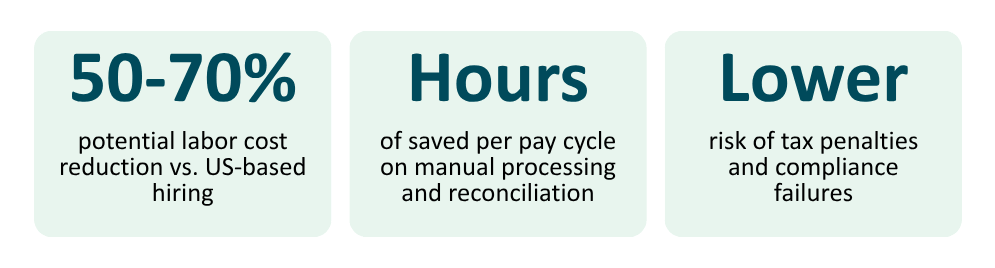
Payroll tax laws change constantly. Federal updates, state-by-state variations, and new reporting requirements. Staying current is a job in itself. Outsourced payroll providers track all of it. When rules change, they adjust. Your business stays compliant without your team having to monitor regulatory updates.
It frees up time for work that actually grows the business
Processing payroll manually takes hours every cycle. Tracking deductions, reconciling discrepancies, and preparing reports adds up. Every hour spent on payroll administration is an hour not spent on hiring, strategy, or customer relationships.
It reduces payroll errors
Errors in payroll aren’t just inconvenient. They erode employee trust, create legal liability, and can result in tax penalties. Providers who specialize in payroll have systems and checks in place specifically to prevent mistakes. Their accuracy rates are typically higher than in-house processing because payroll is what they do all day.
It costs less than most businesses expect
Running payroll internally isn’t free. Factor in the time cost of whoever manages it, payroll software subscriptions, training, and the cost of errors. For many businesses, outsourcing to a specialized provider is cheaper than the status quo. And unlike internal staff, outsourced payroll costs scale with your actual needs.
Employees get a better experience too. Accurate, on-time pay matters. So does access to pay stubs, direct deposit, and clear records. Most outsourced payroll providers offer self-service employee portals that reduce payroll-related questions to HR staff and give employees more visibility into their own pay.
Payroll Outsourcing vs. Payroll Software
This is where a lot of businesses get stuck. Payroll software is widely available, relatively affordable, and gives you more control than a fully outsourced solution. So why outsource at all?
Quick answer: Software gives you tools. Outsourcing gives you people.
| Payroll software works well for | Where software falls short |
|---|---|
| Automating calculations and reducing manual entry | Doesn’t flag potential misclassification issues |
| Integrating with accounting and HR platforms | Won’t alert you to new state regulations |
| Handling direct deposit and basic tax filings | Can’t make judgment calls on complex situations |
| Providing reports and pay stub generation | Compliance failures still land on your business |
An outsourced payroll provider takes on the responsibility, not just the task. There’s accountability on their end. If an error occurs due to their processing, they deal with it. That’s a fundamentally different arrangement than using software where you remain the responsible party.
Outsourcing also includes expertise. When a law changes or a situation arises that doesn’t fit a standard scenario, there’s a person to contact who can work through it. Software has a knowledge base. An outsourced provider has specialists.
Some businesses use both: a payroll software platform that the outsourced provider manages on their behalf, getting the best of both structures.
Which makes more sense for your business?
Payroll software is a good fit if your payroll is simple, consistent, and you have someone reliable managing it. It’s cost-effective and gives you control.
Payroll outsourcing makes more sense when your payroll has grown complex, you operate in multiple states, you’ve experienced compliance issues, or the time investment is pulling your team away from higher-value work.

How to Evaluate a Payroll Outsourcing Provider
Not all payroll outsourcing providers operate the same way. Before committing, a few things are worth examining closely.
- Scope of Services
Make sure you understand exactly what’s included. Some providers handle full-service payroll including tax filings and year-end reporting. Others handle processing only and leave compliance work to you.
- Compliance track record
Ask how they handle tax law changes, multi-state payroll, and situations where requirements vary. If the provider can’t give you a clear answer, that’s worth noting.
- Data security
Payroll data is sensitive. Ask about encryption, access controls, and how they handle data breaches.
- Communication and support
When something needs to be resolved quickly, how do you reach them? What are their response time commitments?
- Integration with your existing systems
Your payroll provider should connect with your accounting software, HR platforms, and time-tracking tools. Manual data transfers between systems create opportunities for errors.
- Transparent pricing
Watch for providers who advertise a low base price but layer on fees for every additional feature. Get a full picture of costs before signing anything.
Final Thoughts
Payroll outsourcing services are not a shortcut. They’re a structural decision that shifts responsibility for a high-stakes business function to specialists who are built to handle it.
For businesses where payroll is simple and well-managed, staying in-house with good software is fine. But for businesses dealing with compliance complexity, time constraints, multi-state operations, or a history of payroll headaches, outsourcing is worth serious consideration.
The businesses that benefit most are the ones that treat it like a real partnership: clear on what they need, deliberate in who they choose, and consistent about communication. When that foundation is in place, outsourcing payroll stops being an expense and starts being a competitive advantage.
Ready to talk about outsourcing payroll?
Guided Outsourcing works with US-based companies to build dedicated remote teams that handle back-office functions accurately and efficiently. Let’s discuss what your operations actually need.